

Fun moves
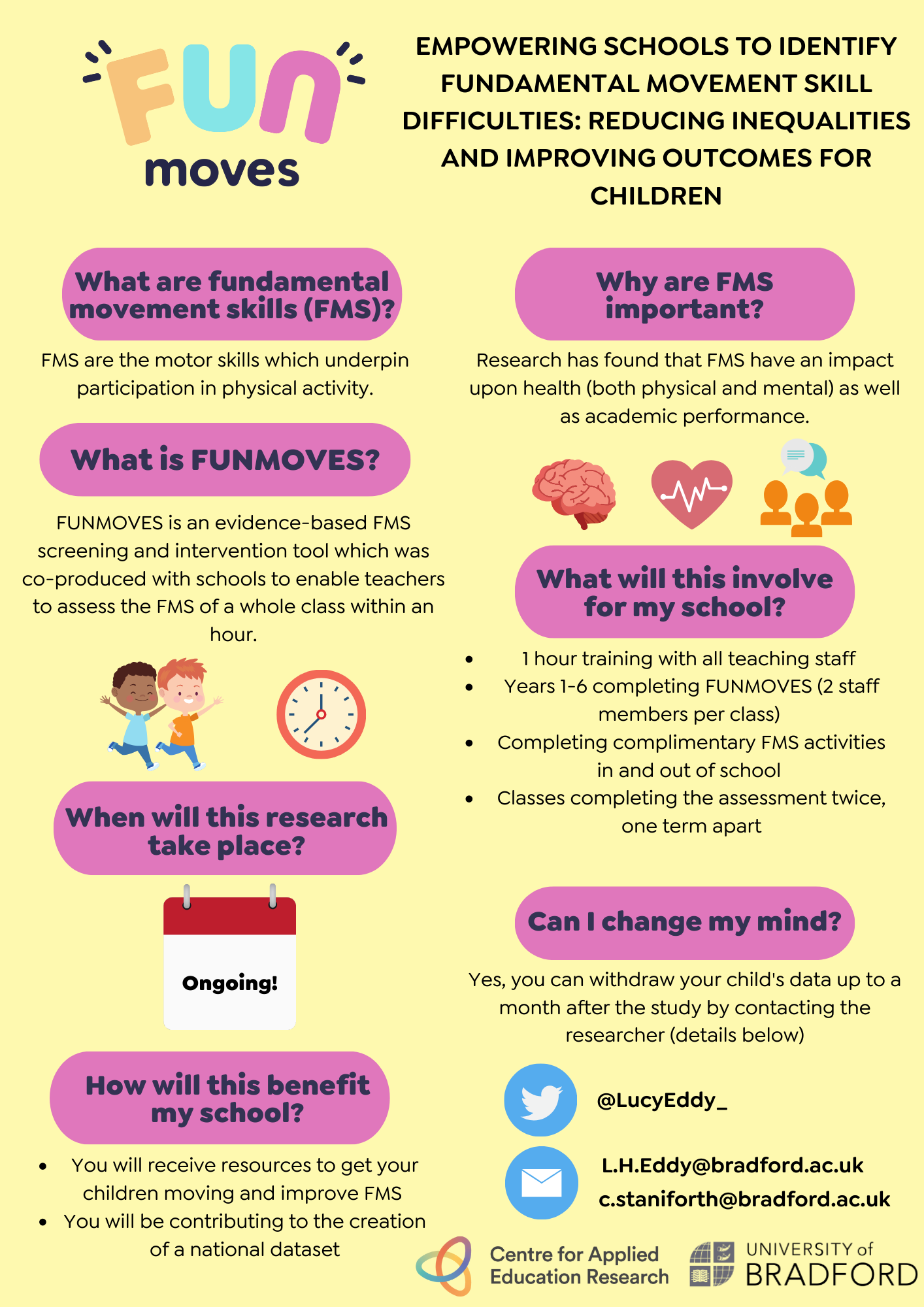
FUNMOVES is a tool designed to assess fundamental movement skills in children. It specifically focuses on a number of motor skills that are central to childhood development such as: running, jumping, hopping, throwing, kicking and balancing.
In Dudley, the therapy services are working with Education to introduce FUNMOVES to all schools in Dudley. This is an evidence based assessment tool which is aimed at whole class participation and can be used in P.E lessons. After completing the screening tool, schools will receive a report detailing how each child has performed. FUNMOVES has an intervention programme that is used in school and at home with the screening repeated at the end. If children are identified as having further difficulties schools will then use the Get Moving programme to provide more targeted intervention.
If your school would like more information on the FUNMOVES assessment and intervention programme please see the recruitment poster (below).
Get Moving:
What is Get Moving?
Get Moving is a school-based excerise programme for children with motor co-ordination difficulties. The programme is for children of all ages, need, and experience of movement, to help to develop motor co-ordination. This is achieved by building foundational movement skills to improve motor co-ordination function.
You can access the school based get moving presentation here: Get Moving Presentation with Voiceover This will provide the training you need to complete the programme in your school.
You can access the Get Moving Toolkit here: Download
You can access the Get Moving Programme (School Age) Here: Get_Moving_Programme-_School_Age.docx
Nursery Get Moving programme:
You can access the Nursery Get Moving Programme here: Download
The CO-OP approach:
What does CO-OP stand for?
It stands for Cognitive Orientation to daily Occupational Performance.
Who uses it?
Occupational Therapists use it as an approach to help children and young people who are having difficulties with their daily occupations.
What does this approach do?
The approach encourages children to problem solve, develop strategies and formulate plans in order to carry out tasks required of them with in their daily lives. Once a family has mastered using this approach with one task it can be generalised to other activities that children are required to learn. The approach is taught within therapy sessions and the family/school are encouraged to use this approach beyond therapy when learning new tasks.
Does the therapist do this on their own?
No, for it to be successful, the child, their family and their teacher/s need to take on the approach and use the same words with the child in order for them to use it in a consistent manner.
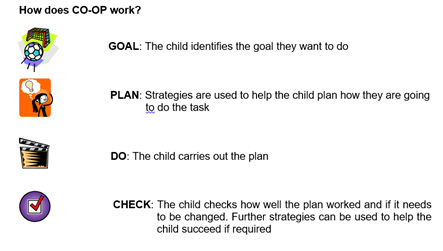
The Inspector Buzz Leaflet explains CO-OP in a child friendly way.
You can access the Inspector Buzz Leaflet here: Inspector Buzz Leaflet PDF
DCD Post Diagnosis Support
Further Information & Advice for Children with Developmental Coordination Disorder (DCD):
CanChild- Children with DCD: At home, at school and in the community (Booklet): https://canchild.ca/en/resources/112-children-with-dcd-at-home-at-school-and-in-the-community-booklet
CanChild- Encouraging Participation In Physical Activities For Children With Developmental Coordination Disorder: https://canchild.ca/en/resources/122-encouraging-participation-in-physical-activities-for-children-with-developmental-coordination-disorder
NHS- DCD Information: http://www.nhs.uk/conditions/developmental-coordination-disorder-dyspraxia/
CanChild- Succeeding at School: Accommodations for Students with Coordination Difficulties: https://canchild.ca/en/resources/127-succeeding-at-school-accommodations-for-students-with-coordination-difficulties
Dyspraxia Foundation- What does Dyspraxia mean?: Dyspraxia Foundation
Watch Me Do It Video Library:
These videos have been produced by Manchester Metropolitan University as their research has shown that watching videos recorded from a first-person perspective can help children with motor coordination difficulties to learn daily living skills.
You can access the Watch Me Do It Video Library here: Video Library - Watch Me Do It Project (mmu.ac.uk)
Hypermobility:
You can access our Hypermobility Resource here: Download Hypermobility Leaflet
